
🔴 Fully Automatic Clay Brick Production Line
🔥 Tunnel Kiln & Tunnel Dryer Based Manufacturing Plant
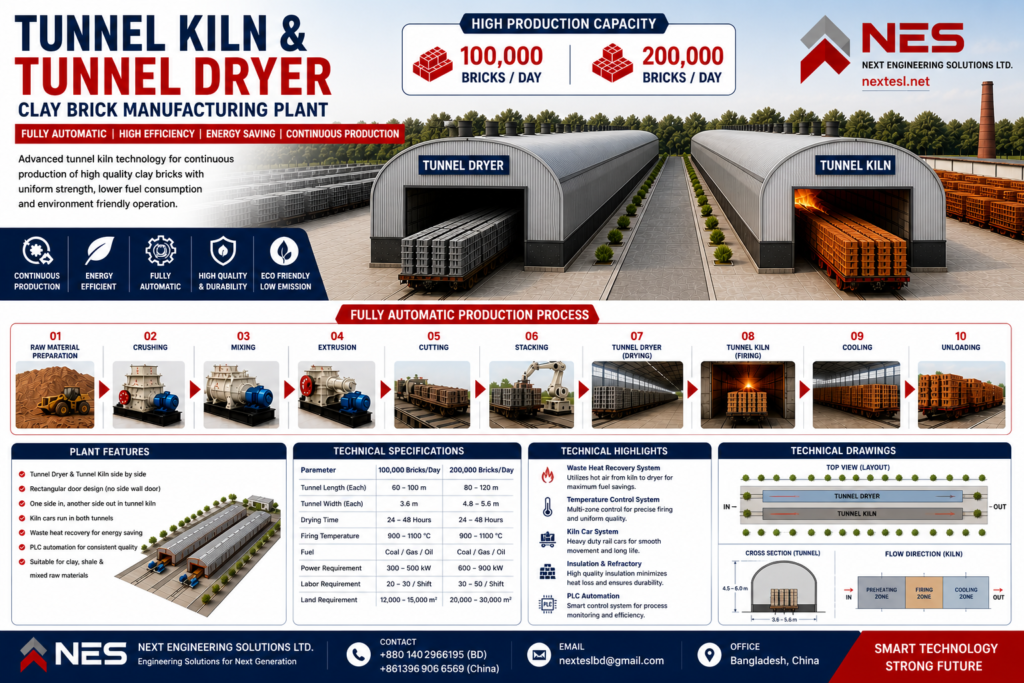
🔷 1. Overview of Tunnel Kiln Clay Brick Plant
A Tunnel Kiln Clay Brick Manufacturing Plant is a modern, fully automated system designed for continuous, large-scale production of high-quality clay bricks. Unlike traditional kilns, this system operates on a continuous flow process, where bricks move through different thermal zones inside a tunnel for drying, firing, and cooling.
The plant integrates advanced technologies such as:
- Automatic raw material preparation
- Vacuum extrusion system
- Automatic cutting and stacking
- Tunnel dryer and tunnel kiln
- PLC/SCADA-based control system
In this system:
- Bricks are loaded onto kiln cars and move slowly through the tunnel
- Heat flows in the opposite direction → maximum energy efficiency
- Waste heat from firing is reused in drying
✔ Key Benefits:
- Uniform brick quality (color & strength)
- Lower fuel consumption
- Reduced labor requirement
- Environment-friendly operation
- Continuous 24/7 production
Tunnel kiln plants are ideal for 100,000 – 200,000+ bricks/day capacity, making them the preferred solution for modern construction industries.
🔷 2. Fully Automatic Production Process Flow
🔄 Step-by-Step Process:
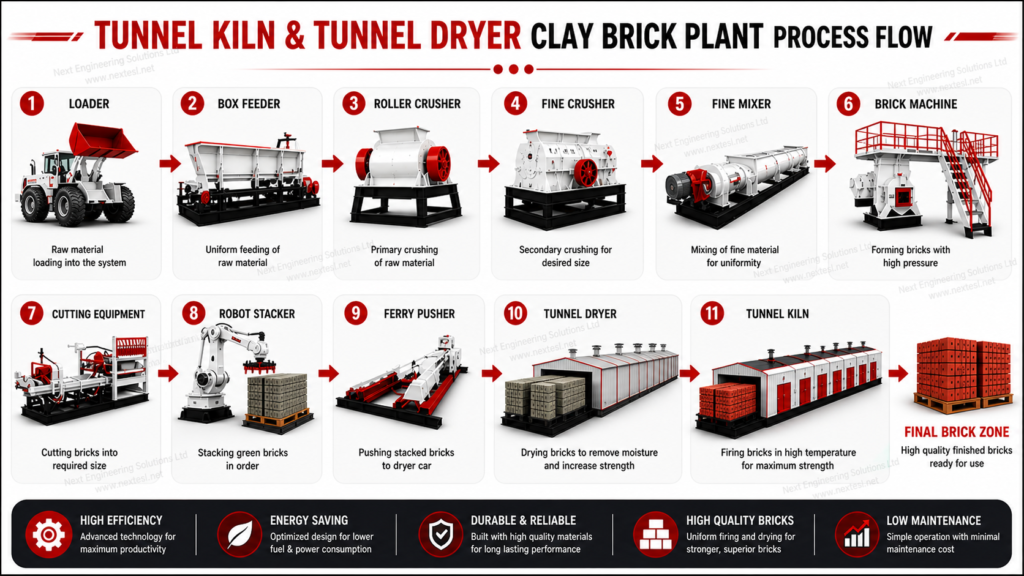
Raw Material Preparation (Clay excavation, storage & aging) → Feeding (Box feeder ensures uniform supply) → Crushing (Roll / hammer crusher reduces size) → Mixing (Double shaft mixer blends clay with water) → Extrusion (Vacuum extruder forms continuous column) → Cutting (Automatic cutter produces green bricks) → Automatic Stacking (Robotic stacking on kiln cars) → Drying – Tunnel Dryer (Moisture removed by hot air) → Firing – Tunnel Kiln (High-temperature burning process) → Cooling (Controlled cooling for strength) → Unloading (Finished bricks sorted & stored)
🔷 3. Tunnel Dryer System
✔ Function:
Removes moisture from green bricks before firing
✔ Technical Details:
- Length: 60–120 meters
- Drying time: 24–48 hours
- Heat source: Waste heat from kiln
- Moisture reduction: ~20% → <2%
✔ Zones:
- Preheating zone
- Constant drying zone
- Cooling zone
🔷 4. Tunnel Kiln System
✔ Function:
Continuous firing of bricks using controlled temperature zones
✔ Technical Details:
- Length: 90–120 meters
- Width:
- 100K plant → ~3.6m
- 200K plant → 4.8–5.6m
- Temperature: 900–1100°C
- Fuel: Coal / Natural Gas / Oil
✔ Zones:
- Preheating zone
- Firing zone
- Cooling zone
🔁 Working Principle:
- Kiln cars move slowly through the tunnel
- Heat flows opposite direction → high thermal efficiency
🔷 5. Single-Line Tunnel System (Combined Dryer + Kiln)
A Single-Line Tunnel System is an advanced design where:
- Dryer + Kiln are combined in one continuous tunnel
🔥 Working Concept:
➡ Green bricks enter
➡ Drying zone
➡ Preheating zone
➡ Firing zone
➡ Cooling zone
➡ Finished bricks exit
✔ Entire process happens in one continuous line
🔧 Technical Details:
- Total length: 120–180 meters
- Dryer section: 40–60m
- Kiln section: 80–120m
- Fully automated temperature & airflow control
⚙️ Key Components:
- Kiln cars
- Circulation fans
- Heat recovery system
- PLC automation
- Fuel firing system
🔷 6. Comparison: Separate vs Single-Line System
| Feature | Separate Dryer + Kiln | Single-Line Tunnel |
|---|---|---|
| Layout | Two systems | One combined system |
| Land requirement | Higher | Lower |
| Investment | Medium | Higher initial |
| Efficiency | High | Very high |
| Heat utilization | Good | Excellent |
| Maintenance | Easier | Slightly complex |
| Automation | High | Very high |
🔷 7. Production Capacity & Requirements
🟢 A. 100,000 Bricks/Day Plant
✔ Requirements:
- Land: 12,000 – 15,000 m²
- Power: 300–500 kW
- Labor: 20–30 workers/shift
- Raw material: ~300 m³/day
✔ Configuration:
- Tunnel dryer + tunnel kiln
- Semi or full automatic stacking
🟢 B. 200,000 Bricks/Day Plant
✔ Requirements:
- Land: 20,000 – 30,000 m²
- Power: 600–900 kW
- Labor: 30–50 workers/shift
- Higher raw material consumption
✔ Configuration:
- Wide tunnel kiln (5.2m+)
- Fully automatic system
- Recommended: Single-line tunnel system
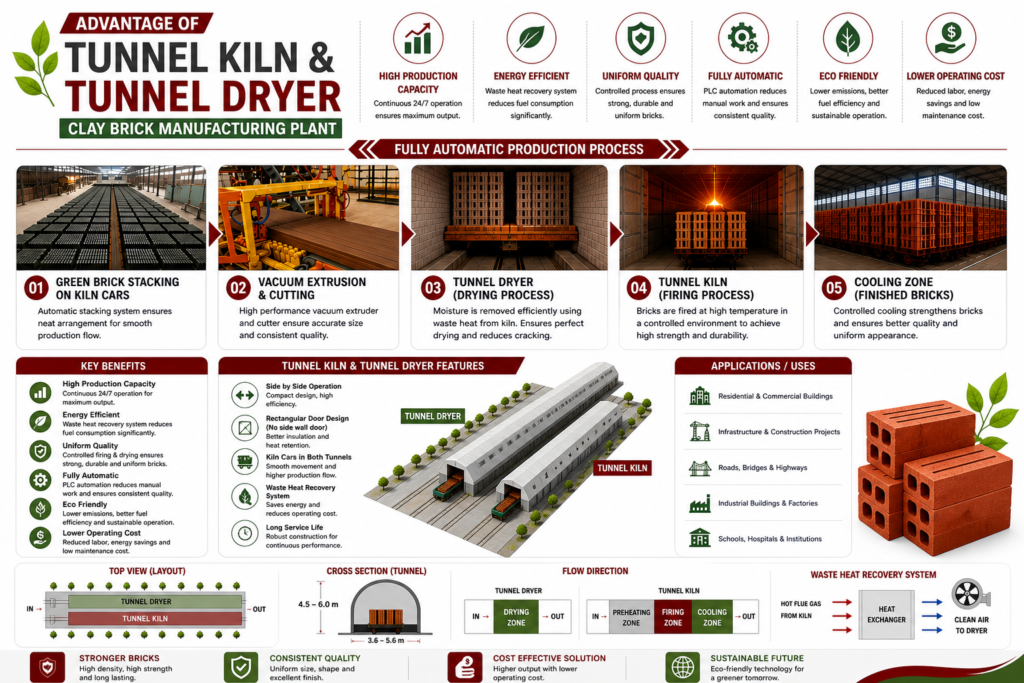
🔷 8. Advantages of Tunnel Kiln Plant
✅ High Production Capacity
- Continuous 24/7 operation
✅ Energy Efficiency
- Waste heat reused in drying
✅ Superior Quality
- Uniform firing → strong bricks
- Less breakage
✅ Automation
- Reduced labor dependency
- Stable production
✅ Environment Friendly
- Lower emissions
- Better fuel efficiency
🔷 9. Comparison: Tunnel Kiln vs Hoffman Kiln
| Feature | Tunnel Kiln | Hoffman Kiln |
|---|---|---|
| Operation | Continuous | Batch |
| Automation | High | Low |
| Labor | Low | High |
| Quality | Uniform | Variable |
| Efficiency | High | Medium |
| Investment | Higher | Lower |
🔷 10. Additional Technical Information
- Raw materials: Clay, shale, fly ash
- Fuel consumption: ~90–120 kg coal / 1000 bricks
- Installation time: 4–6 months
- ROI: 2–4 years
- Products:
- Solid bricks
- Hollow bricks
- Facing bricks
🔷 11. Recommendation
✔ For 100K Capacity:
- Separate tunnel dryer + kiln
- Lower investment, stable output
✔ For 200K Capacity:
- Single-line tunnel system
- Higher efficiency and faster ROI
✅ Conclusion
A Fully Automatic Tunnel Kiln Clay Brick Plant is the most advanced, efficient, and scalable solution for modern brick manufacturing.
It ensures:
- High production capacity
- Energy efficiency
- Consistent quality
- Long-term profitability